![]()
Print ISSN: 0971-1198
Online ISSN:
Author Guidelines
Topics of Interest
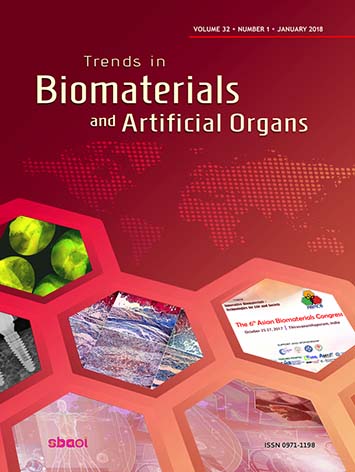
The journal Trends in Biomaterials & Artificial Organs (TIBAO) welcomes the submission of manuscripts with accompanying tables and figures whose topics relate to Physical, Chemical and Biological sciences in Biomaterials Science, Artificial Organs, Tissue Engineering, Regenerative Medicine and Drug Delivery Systems.
Scope of the journal covers synthesis, basic science, engineering, technology, applications and translation of:
- Glasses and Ceramics
- Nanotechnology
- Natural and Synthetic Polymers
- Metals and Alloys
- Dental Materials
- Cells and Tissues
- Composites or a combination
- Diagnostic systems
- Imaging and Sensing Agents
in Biomaterials Science, Artificial Organs and Implantable Devices, Tissue Engineering, Regenerative Medicine and Drug Delivery Systems.
Peer Review Process
The journals peer review submission system is located at https://biomaterials.org.in/tibao/index.php/tibao
This is a web-based submission and review system. Authors may submit manuscripts and track their progress through the system to publication. Reviewers can download manuscripts and submit their opinions to the editor. Editors can manage the whole submission/review/revise/publish process.
Please register at https://biomaterials.org.in/tibao/index.php/tibao
All submitted manuscripts are reviewed initially by the editor. Manuscripts are evaluated according to the following criteria: material is original and timely, writing is clear, study methods are appropriate, data are valid, conclusions are reasonable and supported by the data, information is important, and topic meets the focus and scope of the journal. Manuscripts with insufficient priority for publication are rejected promptly. Other manuscripts are sent to expert consultants for peer review. Peer reviewer identities are kept confidential, but author identities are made known to reviewers. The existence of a manuscript under review is not revealed to anyone other than peer reviewers and editorial staff. Reviewers, whose names are not normally disclosed to the authors, will study all contributions which the Editor deems to be of sufficient significance and interest to be sent for peer review. The criteria by which this initial assessment is made include relevance to the scope of the journal, the originality of the work and its significance to the broad development of the field of biomaterials science, artificial organs, tissue engineering, regenerative medicine and drug delivery systems. Normally a manuscript will be assigned to two reviewers and the initial review takes 30 days.
Types of Articles
The journal Trends in Biomaterials & Artificial Organs (TIBAO) publishes the following types of articles:
Original Research Articles: Results of research in the development and translation of technology in biomaterials science, artificial organs, tissue engineering, regenerative medicine and drug delivery systems; and its applications.
Review Articles: Expert opinion (up to date critical review) in science, technology, translation and applications of biomaterials, artificial organs, tissue engineering, regenerative medicine and drug delivery systems.
Short Communications: Rapid publication of the results of research in the development and translation of technology in biomaterials, artificial organs, tissue engineering, regenerative medicine and drug delivery; and its applications.
Research Letters: Same as Short Communication (see explanation below).
Letters to the Editor: Opinion and responses to articles featured in TIBAO and the brief reports about its applications.
Author Responsibilities
Authors who submit a manuscript to TIBAO confirm that the manuscript has not been published and nor is under consideration for publication elsewhere (except as an abstract or preliminary report). Authors are fully accountable for the accuracy of all references used and all text quoted.
The article's publication is approved by all authors and by the responsible authorities of institutions where the work was carried out.
Ethical Compliance
Authors who submit manuscripts to TIBAO certify and confirm the following:
Studies that involved animals followed the guidelines for the use and care of laboratory animals outlined by their institution and national laws of their country. Authors should obtain IAEC/CPCSEA approval in all projects involving animal experiments. Please include a statement to this effect in the materials and methods section and provide all pertinent information such as the name(s) of the institution that gave approval and the reference number(s). Manuscripts may be rejected by TIBAO if there are concerns that the research was not carried out within an ethical framework.
Permissions
Authors are responsible for obtaining all necessary permissions from the copyright owner for all material reproduced from published sources and submitting a copy of the permission(s) to TIBAO prior to publication. Include full credit in the manuscript’s text, figure legends, and/or in the acknowledgement section, as appropriate.
Manuscript Preparation
Original Research Articles: The manuscripts must be in English. It should be typed on A4 size paper with a margin of at least 25 mm. Use double line spacing throughout. Editable text files should be formatted as Microsoft word documents (*.doc or *.docx). A PDF is not an acceptable submission file. Do not use your word processor’s automated features to create footnotes or reference lists. Each of the following sections should begin on separate pages: Title page (title, author names, affiliation, address etc), Abstract and keywords, Text, Acknowledgments, References, Individual tables and Figure legends. The abstract should be a brief and factual statement of the contents and should not exceed 300 words in length. The main text of the paper should be divided into sections and subsections; Introduction, Materials & Methods, Results & Discussion and Conclusion. Use not more than 10 figures and tables together in the manuscript. Pages should be numbered consecutively beginning with the title page.
Review Articles: Same as for Original Research Articles except the word count should be between 3500 and 5000 words. It should contain an abstract of not more than 300 words.
Short Communications: Short Communications reporting original research should not exceed 1500 words of text and 10 references and may include 2 tables or figures. They may have no more than 5 authors; other persons who have contributed to the study may be indicated in an Acknowledgment, with their permission, affiliation, contribution to the study, and an indication if compensation was received for their role. It must not duplicate other material published or submitted for publication. In general, Short Communications should be divided into the following sections: Introduction, Methods, Results, and Conclusion. It should be double-spaced and a word count should be provided in the first page. They should include an abstract of not more than 200 words. Short Communications considered for publication undergo external peer review.
Research Letters: Research Letters reporting original research should not exceed 750 words of text and 7 references and may include 1 table or figure. They may have no more than 5 authors; other persons who have contributed to the study may be indicated in an Acknowledgment, with their permission, affiliation, contribution to the study, and an indication if compensation was received for their role. Letters must not duplicate other material published or submitted for publication. In general, Research Letters should be divided into the following sections: To the Editor (which serves as an introduction), Methods, Results, and Comment. Research Letters should be double-spaced and a word count should be provided with each letter. They should not include an abstract. Research Letters considered for publication undergo external peer review.
Letters to the Editor: Letters discussing a recent TIBAO article will have the best chance of acceptance if they are received within 8 weeks of the article’s publication. Letters may have no more than 3 authors. They should not exceed 500 words of text and 5 references; letters not meeting these specifications are generally not considered. They should be double-spaced and a word count should be provided. The text of letters should include the names and primary institutional affiliations for all authors, and the e-mail address for the corresponding author. Letters must not duplicate other material published or submitted for publication and should not include unpublished data. Letters will be published at the discretion of the editors and are subject to abridgement and editing for style and content.
General Guidelines
References: References should be numbered consecutively in the text [in square brackets], and collected at the end of the paper in the following styles, for journals, books and proceedings respectively: (the title is optional)
- C.K.S. Pillai, W. Paul, C.P. Sharma, Chitin and Chitosan Polymers: Chemistry, Solubility and Fiber Formation, Prog. Polym. Sci., 34(7), (2009) 641-678. (Reference to a journal publication)
- C.S. Dhanya, Willi Paul, M.R. Rekha, Roy Joseph, Solid lipid nanoparticles of lauric Acid: A prospective drug carrier for oral drug delivery, 2023. J. Molecular Liquids, 380, 121738. (Reference to a journal publication with article number)
- W. Paul, C.P. Sharma, Advances in Wound Healing, Smithers Rapra, UK, 2015. (Reference to a book)
- S.P. Victor, W. Paul, C.P. Sharma, C.P., Eligen® Technology for Oral Delivery of Proteins and Peptides, in: Mucosal Delivery of Biopharmaceuticals: Biology, Challenges and Strategies, Springer, Boston, MA, 2014, pp. 407-422. (Reference to a chapter in a book)
- W. Paul, C.P. Sharma, Fatty acid conjugated calcium phosphate nanoparticles for protein delivery, in: Proceedings of the 8th World Biomaterials Congress 2008, WBC 2008; Amsterdam; Netherlands; 28 May-1 June 2008; Code 93751, p 1026. (Reference to a conference proceeding)
Please note that journal title abbreviations should conform to the practices of Chemical Abstracts.
Illustrations: All illustrations should be numbered in sequence and referred to in the text and caption as figure 1, figure 2, etc. The author's name and the figure number should be clearly shown on the back of each illustration (if hard copy). Original artwork should be sent. Photographs should be positive glossy prints. The soft copy of figures may be uploaded as .tif or .jpg files with the following minimum resolution.
- 300 dpi with 5 x 4 inches (i.e. 1500 pixels (width) x 1200 pixels (height). for color pictures.
- 600 dpi with 5 x 4 inches (i.e. 3000 pixels (width) x 2400 pixels (height). for black and white pictures.
- 1200 dpi with 5 x 4 inches (i.e. 6000 pixels (width) x 4800 pixels (height). for line arts.
- 900 dpi with 5 x 4 inches, (i.e. 4500 pixels (width) x 3600 pixels (height). for combination art (photo and text).
Kindly refer to "Handling digital images for publication" Sci Ed 2014; 12(2): 58-61. http://dx.doi.org/10.6087/kcse.2014.1.58
Units and abbreviations: SI units must be used. All abbreviations should be spelt out in full on first appearance, e.g., scanning electron microscope (SEM).
Cover photographs: The cover photographs are enlarged versions of photographs appearing in the issues. Authors are invited to draw the editor’s attention to a photograph of outstanding scientific importance. Larger copies of these illustrations may be submitted.
Page Proofs: Journal sends page proofs in pdf format via e-mail to the corresponding author’s e-mail address. Please follow the instructions in the e-mail.
Reprints: Reprints of published articles will be supplied on request to authors. This is chargeable. Contact the subscription manager for the same.